

Accepting New Patients

Baby teeth do more than help with biting and chewing. They actively hold the space that permanent teeth need to erupt in the right position. When a baby tooth is lost too early, the neighboring teeth don’t stay put. They begin to drift into the open space, sometimes slowly and sometimes quickly. By the time the permanent tooth is ready to come in, the path it was meant to take no longer exists. The result can be a tooth that comes in blocked, tilted, impacted, or noticeably out of alignment.
A space maintainer is the tool that prevents that from happening. At Silicon Beach Pediatric Dental, Dr. Ray Klein and Dr. Hayley Botwin recommend space maintainers in a specific situation. That’s when a child loses a tooth too early, and the permanent replacement is still far enough off that drifting is a real concern. It’s one of the more straightforward examples of a small step now preventing a much bigger problem later.
Premature tooth loss doesn’t always happen because of an accident or injury. The most common cause is severe tooth decay. That’s early childhood caries that progresses to the point that the tooth can’t be saved, even with a filling or pulp therapy. When extraction becomes the only option, the space that tooth was holding immediately becomes a concern. Other causes of early tooth loss include dental trauma, certain developmental conditions, and in some cases, teeth that simply never formed. Whatever the cause, the question is the same: does this space need active maintenance until the permanent tooth comes in?
The American Academy of Pediatric Dentistry considers space maintenance an important part of preventive orthodontic care, since premature loss of primary teeth can lead to crowding, rotations, and other alignment issues if left unmanaged.
A space maintainer is a custom-fitted dental appliance, usually made of metal. It’s placed in the mouth to hold the gap left by a missing tooth open and stable. It attaches to the neighboring teeth and extends into the space, physically preventing adjacent teeth from migrating. Space maintainers don’t help the permanent tooth erupt. That happens on its own timeline. What they do is make sure the path is still clear when the time comes.
The type of maintainer that works best depends on a few things: the location of the missing tooth, the age of the child, and how many teeth are involved. The main categories are:
Dr. Ray and Dr. Hayley will recommend the type that’s clinically most appropriate for your child’s specific situation, not a standard default.
If a baby tooth is lost very close to when it would have fallen out naturally, a space maintainer may not be necessary. This is especially true if the permanent tooth is already clearly on its way in. Dr. Ray and Dr. Hayley use X-rays to assess where the permanent tooth is in its development and how much time remains before it’s expected to erupt. When the window is short, and the surrounding teeth aren’t yet at significant risk of drifting, monitoring alone may be the right call. When there’s meaningful time left on the clock, a maintainer is almost always worth placing.
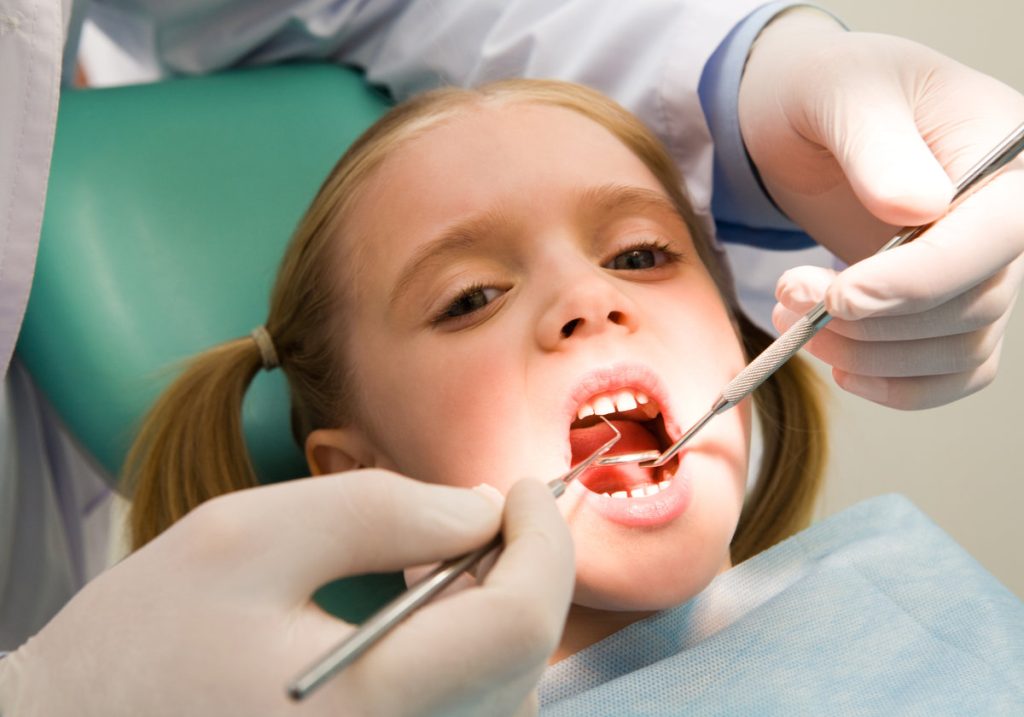
Space maintainers are designed to stay in place and need minimal day-to-day management. That said, a few things help them do their job for as long as they’re needed. Sticky and chewy foods, gummy candy, caramel, taffy, and similar items should be avoided because they can dislodge or bend the appliance. Thorough brushing around the band and wire is important to keep the area clean. If a maintainer feels loose or uncomfortable, or it has shifted noticeably, that’s worth a call to the office. Don’t wait until the next scheduled visit.
We check the space maintainer at every routine appointment to confirm it’s properly seated and functioning. When the permanent tooth begins to erupt and is clearly on track, the maintainer is removed. It’s a quick and painless step that marks the end of one chapter and the beginning of another.

Dr. Ray Klein and Dr. Hayley Botwin think about dental development longitudinally. They’re not just watching what’s happening in your child’s mouth right now, but what’s developing below the gumline and what will matter a year or two from now. Space maintainers are a clear example of that kind of forward-thinking care. Placed at the right time, they quietly do their job in the background and step back when the permanent tooth is ready.
Silicon Beach Pediatric Dental accepts most PPO insurance plans, and space maintainers are typically covered when they’re clinically indicated. If your child has lost a tooth earlier than expected, or you’ve been told an extraction may be necessary, reach out. We’ll talk through the right next steps.
Mon-Fri: 9am – 5pm
We use cookies to improve your experience on our site. By using our site, you consent to cookies.
Manage your cookie preferences below:
Essential cookies enable basic functions and are necessary for the proper function of the website.
CloudFlare provides web performance and security solutions, enhancing site speed and protecting against threats.
Service URL: developers.cloudflare.com (opens in a new window)
These cookies are needed for adding comments on this website.
Google reCAPTCHA helps protect websites from spam and abuse by verifying user interactions through challenges.
Google Tag Manager simplifies the management of marketing tags on your website without code changes.
Statistics cookies collect information anonymously. This information helps us understand how visitors use our website.
Google Analytics is a powerful tool that tracks and analyzes website traffic for informed marketing decisions.
Service URL: policies.google.com (opens in a new window)
Marketing cookies are used to follow visitors to websites. The intention is to show ads that are relevant and engaging to the individual user.
Facebook Pixel is a web analytics service that tracks and reports website traffic.
Service URL: www.facebook.com (opens in a new window)
Google Maps is a web mapping service providing satellite imagery, real-time navigation, and location-based information.
Service URL: policies.google.com (opens in a new window)